





Our Material Matters
Methodology
We recognise that the global banking industry is continuously evolving, with increasing pressure and expectations from society. Materiality assessment is one of our key approaches to identifying the critical economic, environmental and social matters for our organisation, based on inputs from our stakeholders. We apply the concept of double materiality in our approach, considering both the potential impact of our activities on the environment and society, and the environmental and societal matters that may impact our operations. Our material matters guide us in driving long-term value creation and competitiveness for the Group as a whole. The outcome of the materiality assessment enables us to better understand our impacts, risks and opportunities, and to develop comprehensive management strategies.
During our materiality analysis, we considered interlinkages to avoid unintended consequences and maximise positive synergies. This ensures that progress in one area does not undermine another, while unlocking co-benefits across multiple sustainability goals. For example, addressing climate change and nature together helps prevent trade-offs. By prioritising climate action through waste reduction, resource efficiency and circular economy practices, we not only lower greenhouse gas emissions but also reduce pressure on ecosystems, minimising habitat destruction and biodiversity loss. An example of avoiding unintended consequences can be found in sustainable finance. If financial institutions focus solely on financing economic growth without considering environmental or social impacts, they risk enabling activities that drive deforestation, pollution or labour exploitation. Instead, by integrating environmental and social factors into decision-making, we ensure that financial support for MSMEs not only drives job creation and economic inclusion, but does so in a way that aligns with broader sustainability objectives. By embedding interlinkages into our strategy, we create more resilient, long-term solutions that drive systemic impact across multiple dimensions.
We conduct an in-depth materiality assessment every four years, with a midpoint review every two years.
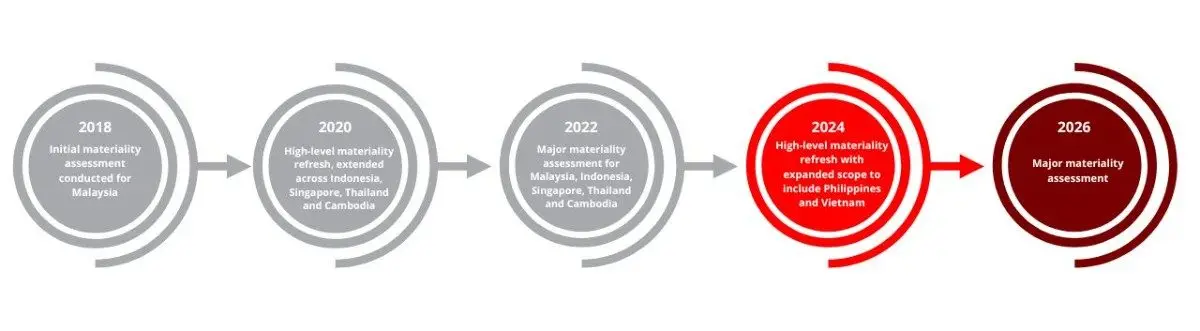
Our materiality assessments are conducted in alignment with the GRI Sustainability Reporting Standards 2021. We refreshed our material matters in 2024.
1
IDENTIFICATION
- We identified a list of 22 potential material topics from various sources, including our 2022 material topics, global trends and standards such as GRI, ISSB, UNEP-FI PRB, S&P Global CSA and stock exchange requirements.
- We also conducted a high-level scan of our peers’ material topics, as well as those of leading global banks.
2
ENGAGEMENT
- We engaged with approximately 4,500 clients, suppliers and employees across Malaysia, Indonesia, Singapore, Thailand, Cambodia, Vietnam and the Philippines through surveys. These surveys were translated into Thai, Indonesian and Khmer.
- We also conducted one-on-one engagements with regulators, investors, communities and members of CIMB’s leadership team.
3
PRIORITISATION
- Inputs from stakeholders were prioritised based on their influence and impact, and were weighted to reflect the relative significance of our presence in the respective countries studied.
4
VALIDATION
- We engaged with management and regional teams to discuss and refine the identified material matters.
- The process and final list of material matters were validated and approved by the Group Sustainability Council and the Board, our highest governing body.
Integration of Materiality Assessment into Enterprise Risk Management
Our materiality assessment helps us better understand the impacts, risks and opportunities arising from various topics, enabling us to develop more comprehensive management strategies. Identified material issues that present significant risks are integrated into our Enterprise-Wide Risk Management Framework and overall risk governance structure. On the other hand, opportunities associated with these material matters are embedded into our business strategies and initiatives. Some examples of our material matters and how we integrate them into our business are outlined below.
| Material Issue | Opportunities | Risks |
|---|---|---|
| Cybersecurity & Data Privacy (mature) | Opportunities to build trust with clients by being transparent in our policies and raising awareness via campaigns.
Build trust with established governance, security and privacy policies and standards
Leverage our existing adoption of globally recognised cybersecurity frameworks such as (NIST, ISO 27001) to enhance resilience against evolving threats
Enhance customer and data protection through fraud and privacy awareness initiatives
Improve fraud detection with advanced risk monitoring | Identification: Engage with relevant stakeholders such as investors and regulators to identify risks.
Assessment: Conduct regular security and impact assessments and risk evaluations.
Prioritisation: Rank risks based on severity and business impact.
Risk Response: Use Cyber Threat Intelligence to continuously monitor threats and risks, complementing periodic vulnerability assessments and penetration tests, and proactively identify potential risks to the Bank. Apply remediation and mitigation controls based on identified threats.
Monitoring and Reporting: Operate the 24/7 Security Operations Centre (SOC) to monitor events in real time using advanced analytics and machine learning. Have the Computer Emergency Response Team (CERT) investigate high-severity alerts from the SOC. |
| Climate Change (maturing) | Develop strategies to expand climate finance, for example in green buildings, electrification and adaptation solutions
Embed these opportunities within our Green, Social, Sustainable Impact Products and Services (GSSIPS) Framework and business strategies
Drive accountability by linking climate finance performance to key performance indicators (KPIs) and compensation
Scale impact through partnerships in blended finance and carbon credit initiatives | Identification: Engage with investors, regulators and civil society to identify risks.
Assessment: Conduct risk evaluations such as sectoral-level transition risk assessments and flood risk analyses to gauge impacts and exposure.
Prioritisation: Focus on high-carbon industries and assess CIMB’s exposure across credit, market and operational risks.
Risk Response: Manage risks through Net Zero target setting, sector policies in the Sustainable Finance Framework and client transition engagement.
Monitoring and Reporting: Track progress using risk appetite dashboards and continuous monitoring, with disclosures aligned with TCFD and IFRS S2. |
| Nature & Biodiversity (nascent) | Support nature conservation through finance solutions and corporate citizenship
Develop innovative financial products that support conservation, such as the EcoSave Savings Account-i which channels the equivalent of 0.2% of total average portfolio balance annually (subject to cap) to conservation projects
Explore new financing mechanisms, such as nature bonds, to fund conservation efforts
Integrate nature conservation into mid-term strategies, leveraging LEAP analysis to assess opportunities and impact | Identification: Engage with investors and civil society to identify nature-related risks.
Assessment: Conduct high-level analysis of impacts and dependencies using the Locate, Evaluate, Assess, Prepare (LEAP) approach as guided by the TNFD framework.
Prioritisation: Conduct high-level nature risk analyses and advance to sector-specific LEAP assessments for deeper insights.
Risk Response: Mitigate outbound impacts through sector guides, NDPE policies and biodiversity risk assessments, while refining approaches through financial impact assessments.
Monitoring and Reporting: Track progress via client action plan completion rates for NDPE policy implementation. |